
Artificial intelligence – celebrated anywhere and everywhere as far as the eye can see. Yet, “I don’t believe we are in an AI bubble,” says Nvidia’s champion, Jensen Huang. When the CEO, cofounder of the world’s first $5tn company, disagrees with conventional wisdom, it stands to ask what even makes a bubble.
Financial bubbles are simple. Before they are formalized in history as a warning to those who follow, fanatics funnel money into an asset, turning a blind eye to logical or traditional analysis. Heated debates arise between economists and investors, as some warn of a catastrophic collapse while others advocate for the new norm. That is, until the bubble bursts.
A quarter of a century ago, the Dotcom Bubble sang the same tune as today’s business world. Both eras introduced emerging technologies that promised to slash costs and boost revenues, enamoring financiers across the globe. Understanding the hidden similarities and glaring differences of these eras could demystify the road ahead.
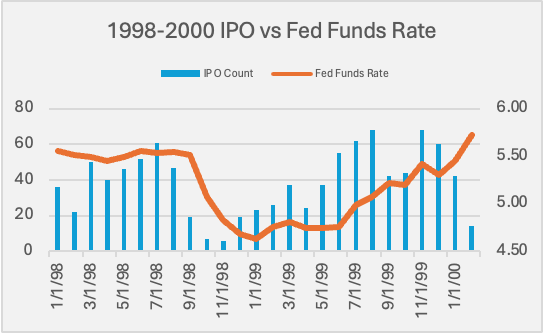
In 1998, following the Asian financial crisis and the LTCM hedge fund collapse, the Federal Reserve implemented three consecutive rate cuts. The decision to cheapen lending was made in an effort to avoid a financial crisis. However, the abundance of liquidity only amplified speculative investments. IPOs nearly doubled, and first-day mean returns tripled in the following year. Today, the Fed navigates yet another crisis: rising inflation, a stagnating labor market, and a lack of economic data. While two consecutive cuts have already passed, a third cut remains uncertain. Furthermore, whereas the 2026 AI IPO lineups lack in volume, SpaceX, OpenAI, and Anthropic make up for in heavy valuation weight.
Another unique trait of the Dotcom Bubble was its round-trip deals, not too dissimilar to recent AI circular deals. Round-trip deals were common among Dotcom companies. AOL, for example, would buy ads on another company’s website, under the agreement that ads would also be purchased on AOL’s website. In the modern day, OpenAI has led the charge on circular deals where companies like AMD would agree to invest in OpenAI. In return, OpenAI would purchase its computing power in the future. The nature of these deals created a cash loop, artificially raising revenue without deriving new profits or customers.
Aside from similarities, there is a key difference between the two eras. The term, ‘Irrational Exuberance’ was coined during the Dotcom era to describe the rampant overvaluation and excitement of internet companies. At the time, an influx of IPOs hit the market with extreme first-day returns, and the Nasdaq surged 600% between 1998 and 2000. Comparatively, the current Nasdaq has returned a little over 100% in the past five years. It was also common for people to quit their careers to become full-time traders, flooding the market with inexperienced investors chasing unfounded euphoria.
In the AI era, exuberance remains at large but wears a different mask. As reported by Ascendix, the US is the global leader in AI. Private investment is estimated to have reached $109.1bn in 2024, nearly 12 times larger than its closest competitor. Concurrently, public AI-related companies such as Palantir and Arm Holdings are also being criticized for their overvaluation. And while a Dotcom-like migration to trading has yet to form, another avenue of inexperienced retail investing may be bubbling beneath the surface.
Michael Burry, the infamous investor who shorted the 2008 housing crisis, has described the rise in passive investments as a bubble in and of itself. Burry warned that the $18tn industry distorts pricing and leads to a concentration in high-market-value stocks, a prevalent issue in today’s indices. As a result, where retail euphoria in the past may have been a conscious decision, today’s concentration into tech stocks seems elusive and deceiving in more ways than one.
Bubbles are marks in history reminding investors of the damage that ensues after overreaching. While similarities between eras can sound alarms, it is not far-fetched to assume that the AI era will differ from its predecessor. However, where the differences lie will be far more catastrophic than their similarities. If history were to heed a warning, it might say that exuberance never hides in the same place twice.
Read the original post here on Substack.
 Calvin Huang