The modern-day whippersnapper is coming up short against an odd labor market. Perhaps it is time to put that damn phone down and try some of that hard work boomers are always parading about. Or perhaps the mounting pressure within the labor market speaks less about the young people’s work ethic, and more as a warning of what is to come.
Unemployment rates for individuals aged 16 to 24 have been on a steady upward trend, reaching 10.6% in November 2025. To put it another way, youth unemployment is at a four-year high with little forecast of slowing. Rising unemployment is already rippling fear through the economy. However, when it comes to the young people of this generation, it stands to ask: Is AI the true Loch Ness monster eating up all the jobs, or is there another, unfamiliar beast hiding in the water?
Bring the Data
With the emergence of AI, corporations are touting their ability to optimize their workforce. However, this augmentation comes at a cost, especially for those at the entry level. A Stanford study examined the employment effects of artificial intelligence. They found that job growth for young workers began to stagnate in 2022, when ChatGPT was published. They noted specific groups, such as workers ages 22-30 and industries with high AI exposure, were particularly vulnerable to the current technological disruption. Early-career software developers, for instance, experienced a decline in employment of nearly 20% between 2022 and 2025.
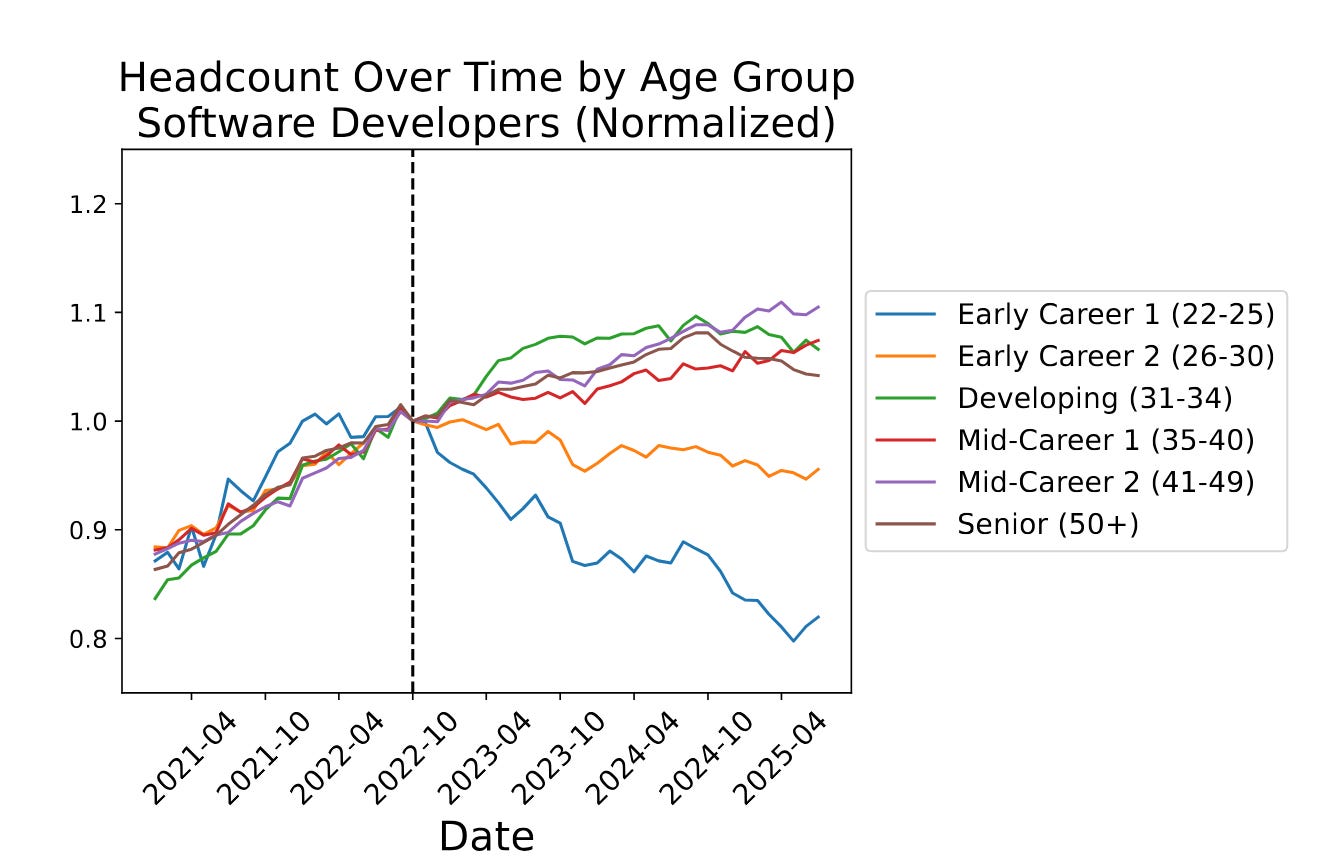
Technology most certainly taketh, but in the grand scheme, it giveths as well. It actually gives quite a lot in return. Or at least this is the argument pitched by Susan Lund, a partner at McKinsey Global Institute, and Richard Cooper, Professor of International Economics at Harvard University, when asked how AI has impacted the labor market. They argued that approximately once a generation, technology evokes fear as it eliminates jobs. However, as the workforce adapts to the new technology, their productivity accelerates, leading to increased opportunities and growth in new, unforeseen industries.
Another study by S&P Global seems reinforce this idea of workforce evolution. This study observed the employees’ and employers’ responses to generative AI. They noted that “firms with greater exposure to Generative AI significantly curtail their job postings after ChatGPT’s release.” They also concluded that both sides of the workforce were forced to make new adaptations to the incoming technology. Employers moved to narrow hiring in capacity and skills, looking for those who could adapt to AI quickly. Meanwhile, employees aimed to rebrand or reposition their skillset to something more AI-related or highlight skills that AI remains weak in.
But here’s the twist
The conclusions appear to be straightforward: AI will change our lives for the better, and young people are simply the new collateral as we enter an era of growth and productivity. A fair assessment and certainly one that media headlines have taken a liking to. However, the writing on the wall comes with a few caveats.
Martha Gimbel, co-founder of the Budget Lab at Yale and self-proclaimed “technology-paced adaptations skeptic,” puts it simply: the acceptance of technologies such that they actually impact labor markets takes time. A lot of time. She points to the Industrial Revolution as a transformative period revered for advancing the quality of life, which also took generations of families to experience its full benefits. Technological disruptions should not be taken lightly; the path to greatness leaves a trail of irreparable damage felt by the majority.
As great as AI may be, it is difficult to believe that we have stumbled on the exception to the rule. Gimbel draws attention to a specific detail in the conclusions drawn by Stanford and S&P Global: In the three years since generative AI’s inception, the impact on the labor market seemed immediate. In her words, “That’s a little weird.” Two critiques come into light: The first is that the immediate impact is almost too fast. Businesses and individuals need time to understand the technologies before implementing them, and subsequently influence the labor market. The second is that ChatGPT’s release coincided with a Fed hiking cycle. The effects of AI are certainly difficult to downplay, but as Gimbel puts it best, “it’s always hard to beat the macroeconomic cycle.”
To put it more bluntly, “What is hurting young people right now is a weak economy,” says Kathryn Anne Edwards, labor economist and host of the Optimist Economy podcast. Young workers, being the group that is ‘first to fire, last to hire’, act as economic indicators themselves. High youth unemployment is usually a signal for weakness, leaving or entering the economy. Edwards argues for the latter, given that youth unemployment last peaked above 10% in 2021, following a downtrend as the economy rebounded from the pandemic.
At first glance, AI may seem like a scapegoat for recessionary pain ahead. However, Edwards layers in another perspective that might explain why AI headlines are not so much sinister as they are ignorant. Considering the intensity and velocity of the previous economic downturns, she believes the financial world may be accustomed to car-crash-like crises or “the economy falling off a cliff.” This is opposite to traditional downturns, which were led by slow and steady marches in unemployment. That march was usually kicked off by the young workers.
To put it another way, as the frog looks for its predator or sudden falling rocks, it may not realize it is sitting in a boiling pot. Youth unemployment is just the first of many bubbles to rise to the surface.
Conclusion
Say what you will, those darn kids set the trend in every generation and, unfortunately, the economy is far from the exception. Even more unfortunate is that the viral trend today may not be the precipice of a new technological age as the media would like us to believe, but rather a throwback to the classics: a stagnating yet vintage type of economic weakness. The struggling young workforce are headwinds for change. And although it is an unfair burden, change starts with us.
Article by Calvin Huang. Read on Substack.
 Calvin Huang